Customer expectations are higher than ever. People want fast, accurate, and empathetic support across phone, chat, email, and social channels. At the same time, service teams are under pressure to do more with less. That is exactly where agent assist software comes in. Acting as an AI-powered co‑pilot, it helps human agents resolve issues faster and deliver consistently excellent experiences. The value of AI in call center operations is clear: it enhances efficiency, reduces errors, and ensures customers get the support they expect, every time.
Implementing AI solutions is no longer optional for businesses striving to meet modern service demands. Many organizations are turning to advanced computing solutions to handle large volumes of customer interactions without compromising quality. By leveraging intelligent systems, teams can focus on meaningful customer engagement rather than repetitive tasks.
For tech enthusiasts exploring the infrastructure behind AI, understanding supercomputers for AI workloads can provide insight into how complex data is processed at lightning speed. This knowledge helps businesses realize why performance matters when adopting agent assist software.
Marketing teams also benefit from AI-driven insights. Platforms like strategies for customer engagement marketing provide ideas on personalizing communications, improving response times, and enhancing overall satisfaction. Combining these marketing insights with AI-powered tools allows service teams to exceed expectations.
Even smaller businesses can capitalize on AI with practical guidance from marketing runners’ resources. Learning how to integrate AI into customer support workflows ensures every agent has real-time suggestions and relevant knowledge at their fingertips.
Financial organizations see measurable benefits too. By consulting top financial resources for AI in customer service, companies can reduce operational costs while improving accuracy and customer trust. This demonstrates the broad potential of agent assist software beyond traditional call centers.
Top 10 Agent Assist Software Solutions for Call Centers
Choosing the right agent assist software can transform customer service operations. These AI-powered tools help agents respond faster, reduce errors, and deliver personalized experiences. Here’s a list of the top 10 solutions, starting with Bright Pattern.
1. Bright Pattern
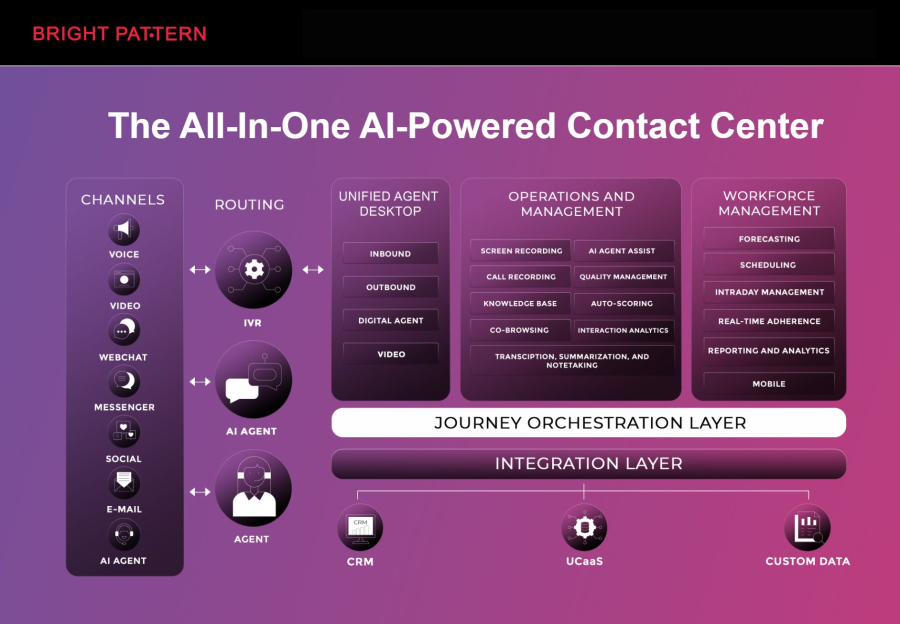
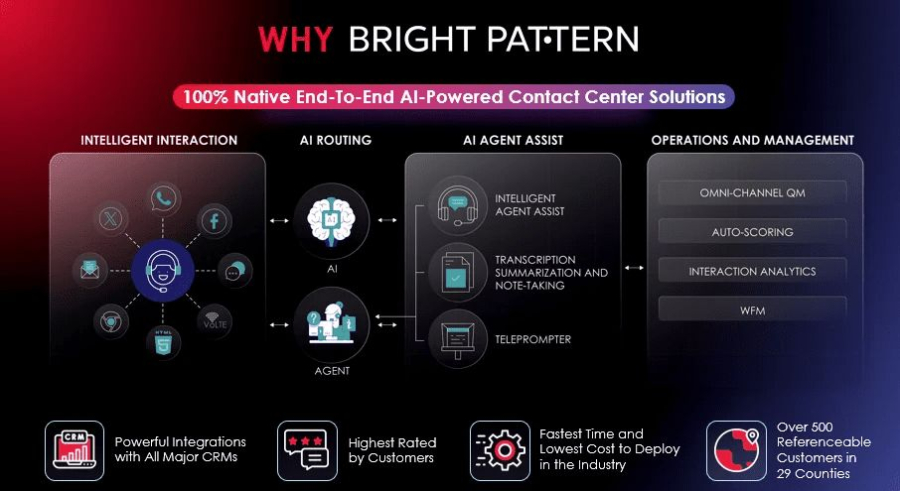
Bright Pattern is a leading agent assist software that integrates AI into every customer interaction, ensuring agents have real-time guidance and suggestions. It is designed for businesses of all sizes, providing a seamless omnichannel experience across phone, chat, email, and social media.
Key features include:
- Real-time AI suggestions for agents during calls or chats
- Omnichannel support in a single platform
- Intelligent routing to the most qualified agent
- Automated workflows to reduce repetitive tasks
- Analytics dashboard for performance tracking
With Bright Pattern, customer service teams can handle high volumes efficiently while maintaining quality, making it one of the most trusted solutions for modern call centers.
2. Five9
Five9 provides cloud contact center software with AI-powered agent assist tools. It supports automated suggestions and predictive dialing to enhance agent productivity.
3. Genesys Cloud CX
Genesys offers a robust agent assist solution that leverages AI to provide recommendations and route customer interactions intelligently.
4. NICE inContact
NICE inContact combines cloud contact center technology with AI assistance, helping agents deliver faster resolutions and personalized customer experiences.
5. Talkdesk
Talkdesk features an AI-driven agent assist platform that supports real-time guidance and workflow automation, improving efficiency and reducing errors.
6. RingCentral Contact Center
RingCentral’s contact center software integrates AI assistance for agents, offering call analytics, knowledge management, and suggested responses to customer inquiries.
7. 8x8 Contact Center
8x8 provides AI-powered agent assist capabilities that guide agents with contextual information and suggested next steps during customer interactions.
8. Zendesk
Zendesk’s AI-powered features help agents by suggesting solutions, automating repetitive tasks, and providing quick access to relevant knowledge articles.
9. LivePerson
LivePerson offers AI-enhanced agent support that provides recommendations, automates routine responses, and ensures consistent service quality across messaging channels.
10. Freshworks
Freshworks integrates AI agent assist tools into its customer service platform, helping agents resolve issues faster and offering data-driven insights to improve customer satisfaction.
What Is Agent Assist Software?
Agent assist softwareis a class of AI tools designed to help customer service agents during live interactions. Instead of replacing agents, itaugmentsthem with real-time guidance, content, and automation so they can focus on high-value, human conversation.
Typically, agent assist tools connect to your existing systems (knowledge base, CRM, ticketing, call center platform) and use artificial intelligence to understand what is happening in the conversation. Then they surface helpful suggestions, automate repetitive steps, and reduce manual effort.
How Agent Assist Software Works
While implementations vary, most agent assist solutions follow a similar pattern: they listen, interpret, and act.
Core capabilities
- Real-time conversation understanding:AI models analyze voice or text as it happens to identify intent, topics, and customer sentiment.
- Suggested responses and knowledge:The tool recommends the best replies, knowledge articles, or workflows based on the current context.
- Guided workflows:Step-by-step prompts help agents follow standard operating procedures, troubleshoot issues, or complete processes accurately.
- Automatic summaries and notes:After (or even during) an interaction, the software drafts call notes, case summaries, and next steps for the agent to review and approve.
- Automation of repetitive tasks:Common actions—such as updating fields, logging activities, or triggering follow-up emails—can be automated to save time.
- Quality and compliance checks:Real-time nudges help agents meet compliance, scripting, or brand standards while they are still on the interaction.
Where agent assist fits in your service stack
- Call centers and contact centers:Live call guidance, next-best-action prompts, and post-call summaries.
- Live chat and messaging:Suggested replies, macros, and article links tailored to each conversation.
- Email and ticketing queues:Draft responses and summarized ticket context to accelerate back-and-forth communication.
- Field service and technical support:On-the-spot troubleshooting steps, diagrams, and knowledge suggestions for complex issues.
The Business Benefits of Agent Assist Software
The right agent assist solution creates measurable value across your entire support organization. Below are some of the most powerful benefits.
1. Faster resolution times
When answers, workflows, and next steps are suggested in real time, agents spend less time searching, asking colleagues, or putting customers on hold. This can meaningfully reduce metrics such as handle time and time to resolution, while keeping conversations more fluid and natural.
2. Higher first-contact resolution (FCR)
Agent assist gives less experienced team members access to the same insight and expertise as your top performers. With guided workflows and instant knowledge suggestions, agents can often solve more issues in a single interaction rather than escalating or requesting follow-up.
3. More consistent, higher-quality interactions
Scripts, policies, and best practices are embedded in the software, so they are easy to follow. Agents receive real-time reminders about required disclosures, brand language, and troubleshooting steps. This consistency helps:
- Protect your brand voice across all channels.
- Reduce errors, omissions, and accidental policy violations.
- Ensure a reliably high standard of service, regardless of which agent handles the case.
4. Reduced agent effort and burnout
Service roles can be stressful, especially when agents juggle multiple systems, complex products, and demanding customers. Agent assist software takes on a portion of the cognitive load by handling routine tasks, note-taking, and knowledge lookups. That means agents can focus more on listening, empathizing, and problem-solving—work that is more satisfying and less exhausting.
5. Faster onboarding and upskilling
New hires no longer need to memorize every product detail or policy before they are productive. With context-aware hints and guided workflows, they can ramp up quickly and learn on the job. Over time, agents are continuously exposed to best-practice responses and resolutions, which reinforces learning and helps the whole team level up.
6. Stronger customer experience and loyalty
Customers feel the difference when interactions are efficient, informed, and empathetic. With agent assist:
- Customers receive accurate information the first time.
- Hold times and transfers are reduced.
- Agents have more mental space to build rapport and personalize responses.
The result is often higher satisfaction, improved loyalty, and more opportunities to grow long-term customer value.
Real-World Use Cases for Agent Assist Software
Agent assist technology can be applied across many types of service operations. Here are some common, high-impact scenarios.
Complex technical troubleshooting
In technical support environments, agents may need to navigate intricate troubleshooting trees or product configurations. Agent assist tools can surface the right diagnostic steps based on the customer’s issue and environment, reducing escalations to specialists and shortening time to resolution.
Compliance-heavy interactions
In regulated industries such as financial services, healthcare, or insurance, agents must follow strict protocols and disclosure requirements. Agent assist can:
- Highlight required disclaimers at specific points in a conversation.
- Prompt agents to ask for necessary information to meet regulatory standards.
- Flag potential compliance gaps in real time so they can be corrected immediately.
Sales-assisted support and upsell opportunities
Support teams often identify moments when a different plan, product, or add-on would better serve the customer. Agent assist can help by suggesting:
- Contextual offers aligned with the customer’s current situation.
- Cross-sell and upsell options that match expressed needs.
- Recommended talking points to communicate value clearly and ethically.
Multilingual customer support
Some agent assist platforms can work alongside translation tools to help agents handle interactions in multiple languages. Even without automated translation, guidance and knowledge suggestions reduce the complexity of supporting a global customer base, since agents can quickly locate localized or region-specific information.
Distributed and remote teams
As hybrid and remote work have become standard, it is harder to rely on over-the-shoulder coaching. Agent assist provides built-in coaching during live interactions, ensuring that remote agents receive real-time support similar to what they would get in an on-site contact center.
Key Features to Look For in Agent Assist Software
Not all solutions are the same. When evaluating agent assist tools, consider the following capabilities and how they align with your goals.
| Feature | Why it matters |
| Real-time suggestions | Ensures agents get guidance while the interaction is still in progress, when it has the greatest impact. |
| Knowledge base integration | Connects directly to your existing documentation and FAQs so content is always accurate and up to date. |
| CRM and ticketing integration | Allows the AI to use customer history, account data, and case details to tailor its recommendations. |
| Omnichannel support | Delivers a consistent experience across voice, chat, email, and messaging channels from a single platform. |
| Configurable workflows | Lets you codify your unique processes and best practices instead of relying on one-size-fits-all flows. |
| AI summarization and note-taking | Reduces after-call work by drafting summaries and action items for agents to review and finalize. |
| Quality and compliance monitoring | Provides real-time nudges, plus post-interaction insights for coaching and continuous improvement. |
| Security and privacy controls | Protects sensitive data with permissions, encryption, and clear governance over what the AI can access. |
| Analytics and reporting | Makes it easy to track performance, adoption, and business impact with actionable insights. |
Best Practices for a Successful Agent Assist Rollout
To unlock maximum value from agent assist software, implementation and change management are crucial. These best practices help ensure strong adoption and results.
1. Start with clear goals and use cases
Before selecting a tool, define what success looks like. Examples of focused goals include:
- Reduce average handle time for specific call types.
- Increase first-contact resolution on key product lines.
- Shorten onboarding time for new agents.
- Improve quality scores or compliance adherence in targeted queues.
With clear goals, you can prioritize features, design relevant workflows, and measure impact effectively.
2. Involve agents early and often
Agents are the primary users, so their feedback is critical. Involve them by:
- Running discovery sessions to understand pain points and manual work.
- Including front-line agents in tool evaluation and pilot programs.
- Documenting and incorporating their suggestions into workflows and prompts.
When agents feel consulted instead of dictated to, they are far more likely to embrace the new technology.
3. Start small with a pilot and iterate
Instead of trying to transform your entire operation overnight, begin with a pilot group or a limited set of use cases. This allows you to:
- Gather real-world feedback in a controlled environment.
- Refine prompts, workflows, and configurations based on live usage.
- Build internal case studies and champions before scaling.
4. Provide training focused on "assistant" not "replacement"
Agents may worry that AI tools could replace their roles. Address this directly in training and communication. Emphasize that agent assist is designed to:
- Automate low-value, repetitive tasks.
- Empower them to do more complex and rewarding work.
- Support better performance and career development.
Training should be hands-on, with real scenarios that show how the tool reduces friction in their daily workflow.
5. Keep humans in control
Agent assist works best when it augments human judgment, not overrides it. Maintain a model where:
- Agents can always edit or decline suggested responses.
- Critical decisions remain with trained human staff.
- Supervisors review AI suggestions regularly to ensure quality.
6. Continuously improve content and workflows
Agent assist tools are only as strong as the knowledge and processes behind them. Use analytics and qualitative feedback to:
- Identify gaps in your knowledge base.
- Update workflows and scripts based on new products or policies.
- Retire outdated suggestions that no longer fit.
This continuous improvement loop keeps your AI assistant sharp and aligned with your evolving business.
Measuring the Impact of Agent Assist Software
To demonstrate value and secure ongoing support, you need to track results. Useful metrics include:
- Operational efficiency:Average handle time, after-call work time, time to resolution, and agent utilization.
- Service quality:Quality assurance scores, compliance adherence, and error rates.
- Customer experience:Customer satisfaction (CSAT), net promoter score (NPS), and customer effort score (CES).
- Agent experience:Agent satisfaction surveys, training time, and turnover or retention rates.
- Business outcomes:Renewal rates, expansion revenue influenced by support, and cost per contact.
Comparing these metrics before and after implementation—starting with your pilot group—helps you quantify the contribution of agent assist to your broader customer experience strategy.
A Simple Roadmap for Implementing Agent Assist
Implementations vary, but many successful organizations follow a similar phased approach.
- Discovery and goal-setting:Map key journeys, identify friction points, and choose high-impact use cases as your starting point.
- Solution selection:Evaluate tools based on features, integrations, security, and alignment with your existing tech stack and roadmap.
- Pilot design:Select pilot teams, define success metrics, configure core workflows, and prepare training materials.
- Pilot launch and iteration:Roll out to a small group, capture data and feedback, and refine configurations and content.
- Scale and standardize:Expand to more teams and channels, codify best practices, and embed agent assist into onboarding and coaching.
- Optimize and innovate:Continuously tune prompts, add new use cases, and integrate deeper with systems as the organization matures.
The Future of Customer Service with Agent Assist
Agent assist software is rapidly becoming a core component of modern customer service operations. As AI capabilities advance, these tools are expected to:
- Offer even more accurate and nuanced understanding of complex customer intents.
- Proactively surface upsell, retention, and personalization opportunities based on live context.
- Collaborate smoothly with customer-facing chatbots and self-service portals to create seamless journeys.
- Provide richer coaching insights that help managers develop their teams faster and more effectively.
Most importantly, agent assist keeps people at the center. By handling repetitive tasks and amplifying human strengths, it enables support professionals to do what they do best: build trust, solve problems creatively, and create memorable experiences that keep customers coming back.
Bringing It All Together
Agent assist software is more than a productivity tool; it is a strategic investment in your customers and your people. When thoughtfully implemented, it helps you:
- Deliver faster, more accurate support across every channel.
- Empower agents with real-time guidance and reduced busywork.
- Standardize quality while preserving human warmth and empathy.
- Unlock new levels of insight into both customer needs and agent performance.
As customer expectations continue to rise, organizations that pair skilled human agents with powerful AI assistants will be best positioned to stand out. Investing in agent assist today sets the stage for a more efficient, more human, and more rewarding customer service experience tomorrow.
